
If you’ve dealt with a knee injury, surgery, or a nagging ache that just won’t quit, you’ve probably been told to “rest it.” But rest alone rarely gets a knee back to where it needs to be.
The best knee strengthening exercises for recovery aren’t about babying the joint — they’re about rebuilding the muscles around it so the knee has the support it needs to move without pain.
At Zarett Rehab & Fitness, we see this pattern constantly: patients who come in for physical therapy and have rested for weeks, only to find their knee feels more unstable, not less. That’s because the knee joint itself has very little muscle of its own. It relies almost entirely on the quads, hamstrings, glutes, and calves to absorb force and control movement.
When those muscles weaken from disuse, the knee is left to take on stress it was never designed to handle alone.
This guide walks through the exercises that work, why they work, and how to progress them safely — whether you’re coming back from an injury, a surgery, or just persistent discomfort that’s been slowing you down.
Why Strengthening Beats Rest for a Recovering Knee
For decades, the go-to advice for knee pain was some version of “stay off it.” The problem is that muscle doesn’t wait around patiently while you heal — it starts to weaken almost immediately once you stop loading it.
Research on knee osteoarthritis has repeatedly shown that quadriceps strength is directly tied to knee function and long-term outcomes, and that muscle-strengthening interventions measurably reduce pain and stiffness compared to no intervention at all.
In other words, a weak knee doesn’t get stronger by doing less. It gets stronger by reintroducing controlled, progressive load — which is exactly what the best knee strengthening exercises for recovery are designed to do.
The goal isn’t to push through pain; it’s to give the joint the support system it’s currently missing.
What Muscles Actually Support the Knee?
Before jumping into exercises, it helps to understand what you’re actually training. The knee is a hinge joint sitting between two long levers — the femur and tibia — and it depends entirely on the muscles around it for stability:
- Quadriceps: The primary shock absorber on the front of the thigh, critical for controlling how the knee bends under load.
- Hamstrings: Work opposite the quads to stabilize the knee, especially during deceleration and change-of-direction movements.
- Glutes: Often the missing link in knee pain. Weak glutes let the thigh rotate inward, placing uneven stress on the knee joint.
- Calves: Help absorb impact at the ankle before it ever reaches the knee.
This is why an effective program of knee rehab exercises Philadelphia patients rely on rarely isolates the knee. It trains the entire kinetic chain, from the hip down to the ankle, so the joint isn’t working in isolation.
Best Knee Strengthening Exercises for Recovery: Quad-Focused Moves
The quadriceps are usually the first muscle group to weaken after a knee injury or surgery, and often the slowest to recover without direct attention. These foundational moves are typically where recovery begins:
- Quad Sets (Isometrics): Sit with your leg extended and gently press the back of your knee into the floor, tightening the muscle on top of your thigh. No joint movement is required, which makes this one of the safest starting points after surgery or an acute flare-up.
- Terminal Knee Extensions: Using a resistance band anchored behind you, step forward and straighten your knee against the band’s tension. This targets the final few degrees of extension, which is often where quad weakness shows up first.
- Mini Squats: Partial-range squats (bending to roughly a quarter or half squat) build strength without placing excessive shear force on a healing joint.
- Wall Sits: A static hold against a wall builds quad endurance and tolerance to sustained load, which mimics real-world demands like standing or stair climbing.
These moves form the backbone of nearly every effective knee rehab program, because a strong quad is the single biggest factor in how well a knee tolerates daily activity.
Hip and Glute Exercises That Protect the Knee
One of the most overlooked pieces of knee rehab is that a lot of knee pain doesn’t actually originate at the knee. As we’ve covered in our breakdown of runner’s knee, weak hip abductors are a major driver of “knee valgus” — the inward collapse of the knee that happens during walking, squatting, or running.
When the hips can’t control rotation, the knee absorbs the consequences.
Strengthening the muscles around the hip is one of the most effective ways to take pressure off a recovering knee:
- Glute Bridges: Build posterior chain strength and teach the hips to extend properly, reducing the load the quads and knee have to take on alone.
- Clamshells: A simple, low-impact way to isolate the glute medius, which is responsible for keeping the knee tracking in line during movement.
- Lateral Band Walks: Adding resistance to side-stepping trains the hip to actively resist collapse, which directly protects the knee joint during dynamic movement.
If you’ve been through PT for a hip or knee issue before, these moves will likely look familiar — they’re a cornerstone of nearly any well-built knee rehab exercises Philadelphia clinics use, because the hip-knee connection shows up in nearly every case we treat.
Low-Impact Cardio to Support Knee Recovery
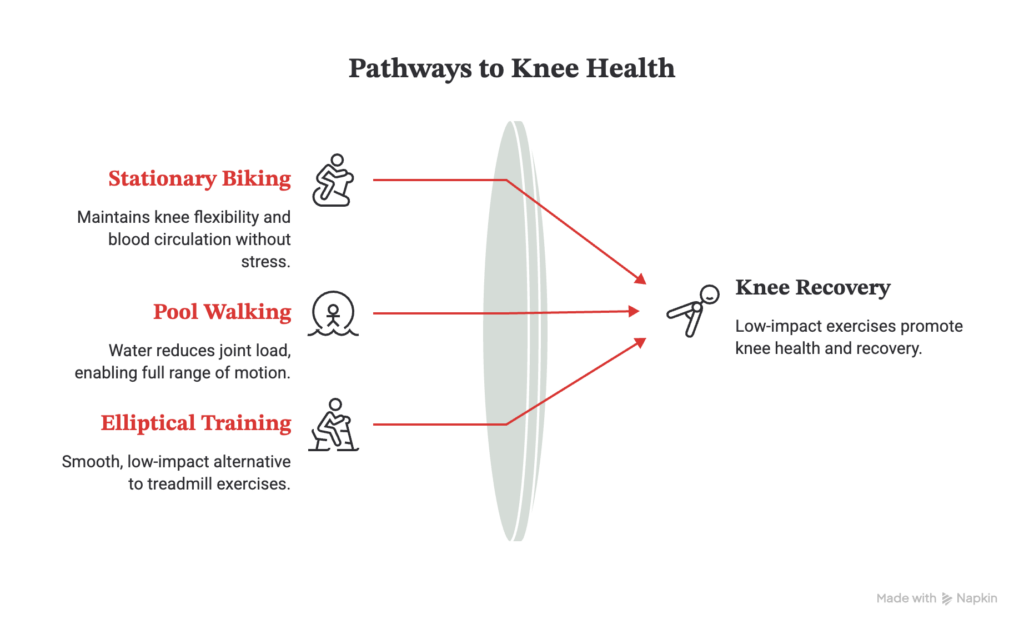
Staying active during recovery doesn’t have to mean staying off your feet completely. The key is choosing cardio that loads the knee through a controlled range of motion without the repetitive impact of running or jumping:
- Stationary Biking: Excellent for maintaining range of motion and blood flow without axial loading on the joint.
- Pool Walking or Aqua Therapy: Water reduces body weight load significantly, allowing you to move through a full range of motion with far less stress on the joint.
- Elliptical Training: A middle ground between biking and walking, offering a smoother, lower-impact alternative to the treadmill.
These options let you preserve cardiovascular fitness and joint mobility while your strengthening program does the heavier lifting — often quite literally.
How to Progress Safely After Injury or Surgery
One of the most common questions we get is simply: how do I know when to add more? The answer isn’t about the calendar — it’s about how your knee actually responds.
A helpful general guideline: mild discomfort that settles within about 24 hours is typically a normal part of progressing load. Sharp pain, or noticeable swelling that lingers, is a sign to back off and reassess. Progression through the best knee strengthening exercises for recovery should be criteria-based — driven by your strength, control, and how the joint responds — not by how many weeks have passed since your injury or surgery.
This is also where working with a physical therapist matters most. At Zarett, our physical therapy team builds individualized progressions based on your specific presentation, rather than a generic timeline pulled from a handout.
Common Mistakes to Avoid When Strengthening a Recovering Knee
We see two opposite mistakes play out constantly with self-guided knee rehab:
- Pushing through sharp pain. Discomfort during exercise is sometimes expected, but sharp, localized pain is your body telling you the load is too much, too soon.
- Staying too cautious for too long. On the flip side, some patients get so nervous about re-injury that they never reintroduce meaningful load, which leaves the knee weak indefinitely.
Another frequent gap: only training the knee in isolation and skipping the hip and ankle work that actually supports it. And if you spend most of your day at a desk, poor sitting posture can quietly compound knee and hip tightness over time — our guide on fixing desk posture is a good companion resource if that sounds familiar.
When to See a Physical Therapist for Knee Pain
Self-guided exercise can go a long way, but it has a ceiling — especially after surgery, or if you’re dealing with persistent swelling, instability, or pain that isn’t improving after a few weeks of consistent effort.
In Pennsylvania, you don’t need a physician referral to get started. Under Direct Access, you can begin treatment at Zarett Rehab & Fitness for up to 30 days without a script. If you’re unsure what that first visit looks like, our guide on what to expect from the best physical therapy clinic walks through the entire process, from your first evaluation to your home exercise program.
Final Thoughts
Recovering a knee isn’t about avoiding movement — it’s about reintroducing the right movement, in the right order, at the right pace. The best knee strengthening exercises for recovery work because they rebuild the entire support system around the joint: the quads, hamstrings, glutes, and calves that were designed to protect it in the first place.
If you’ve been managing knee pain on your own and feel like you’ve hit a plateau, or you’re recovering from a recent injury or surgery, our team at Zarett Rehab & Fitness can build a plan tailored to exactly where you are.
Ready to get your knee back to full strength? Schedule your evaluation at Zarett Rehab & Fitness today.

