
Lorem ipsum dolor sit amet, consectetur adipiscing elit. Ut elit tellus, luctus nec ullamcorper mattis, pulvinar dapibus leo.
Muscle Soreness vs. Joe Zarett Explains the Difference
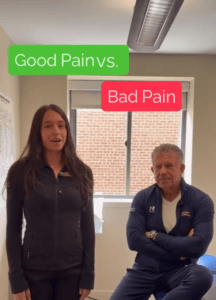
Knowing muscle soreness vs pain decides whether you keep training or get checked by a physical therapist. In our latest Instagram video, Joe Zarett, a Philadelphia physical therapist, explains the difference to Chaundy Titus, one of our exercise physiologists. Soreness after a hard workout is normal and fades on its own. Sharp pain is different, and it’s worth an evaluation.
What Muscle Soreness Feels Like
Delayed onset muscle soreness, or DOMS, typically starts 12 to 24 hours after unfamiliar or hard exercise. It peaks between 24 and 72 hours and fades within about a week. It feels dull, achy, tender, and stiff across a broad area of muscle, often on both sides. Gentle movement usually eases it. A burning, tired feeling in the muscle during a set is normal fatigue.
Soreness Isn’t Caused by Lactic Acid
Lactic acid builds up in muscle during hard exercise, but Houston Methodist reports it’s generally gone within about an hour. Soreness starts many hours later. It’s linked to microscopic muscle damage and the inflammation that repairs it, though researchers haven’t pinned down the exact mechanism.
What Injury Pain Feels Like
Injury pain often starts suddenly during an activity, such as a twist, an awkward landing, or a heavy lift. It tends to be sharp, stabbing, or burning, and it sits in one spot, often a joint or tendon rather than the belly of a muscle. It may come with swelling, bruising, weakness, numbness, or a pop. It can ache at rest or keep you up at night, and it doesn’t improve the way soreness does.
Four Questions to Sort It Out
1) When did it start? During the activity points toward injury. A day later points toward soreness.
2) Where is it? A broad muscle ache is typical soreness. A specific spot, especially in or around a joint, may be an injury.
3) What does movement do? Soreness often eases as you warm up. Injury pain tends to flare or stay the same.
4) Is it improving? Soreness gets better day by day after it peaks. Injury pain stays or worsens.
What to Do
For soreness, keep moving gently, rest the muscles you trained, and ease back in. For sharp pain, stop the activity that triggers it. Training through pain, especially in a joint, may make an injury worse.
When to See a Physical Therapist in Philadelphia
Get checked if the pain is sharp or in one spot, comes with swelling or bruising, doesn’t improve after about a week, limits daily activity, or keeps coming back. A PT can find the cause and tell you what’s safe to keep doing.
Go to urgent care or the ER if a joint looks deformed, you can’t put weight on it, or you have numbness after an injury. Dark urine with muscle cramps or fatigue after hard exercise needs a doctor right away, according to UW Medicine.
At Zarett
Zarett has been a Philadelphia physical therapy and fitness center since 1995, just off Rittenhouse Square. An evaluation looks at where it hurts, how you move, and what sets it off, then builds a plan that keeps you training safely. Feel free to schedule an appointment with us.

Mikael La Ferla
Mikael La Ferla is the Marketing Manager at Zarett Rehab & Fitness, a physical therapy and fitness clinic in Philadelphia. He writes about physical therapy, injury recovery, and staying active in Philadelphia, working with Zarett’s physical therapists to turn clinical expertise into practical guidance for patients. Mikael holds an MBA from Rutgers University and is also a Senior Accountant at PMC Property Group, bringing a background in finance to his work in healthcare marketing. Outside the office, he enjoys cooking and playing squash.
